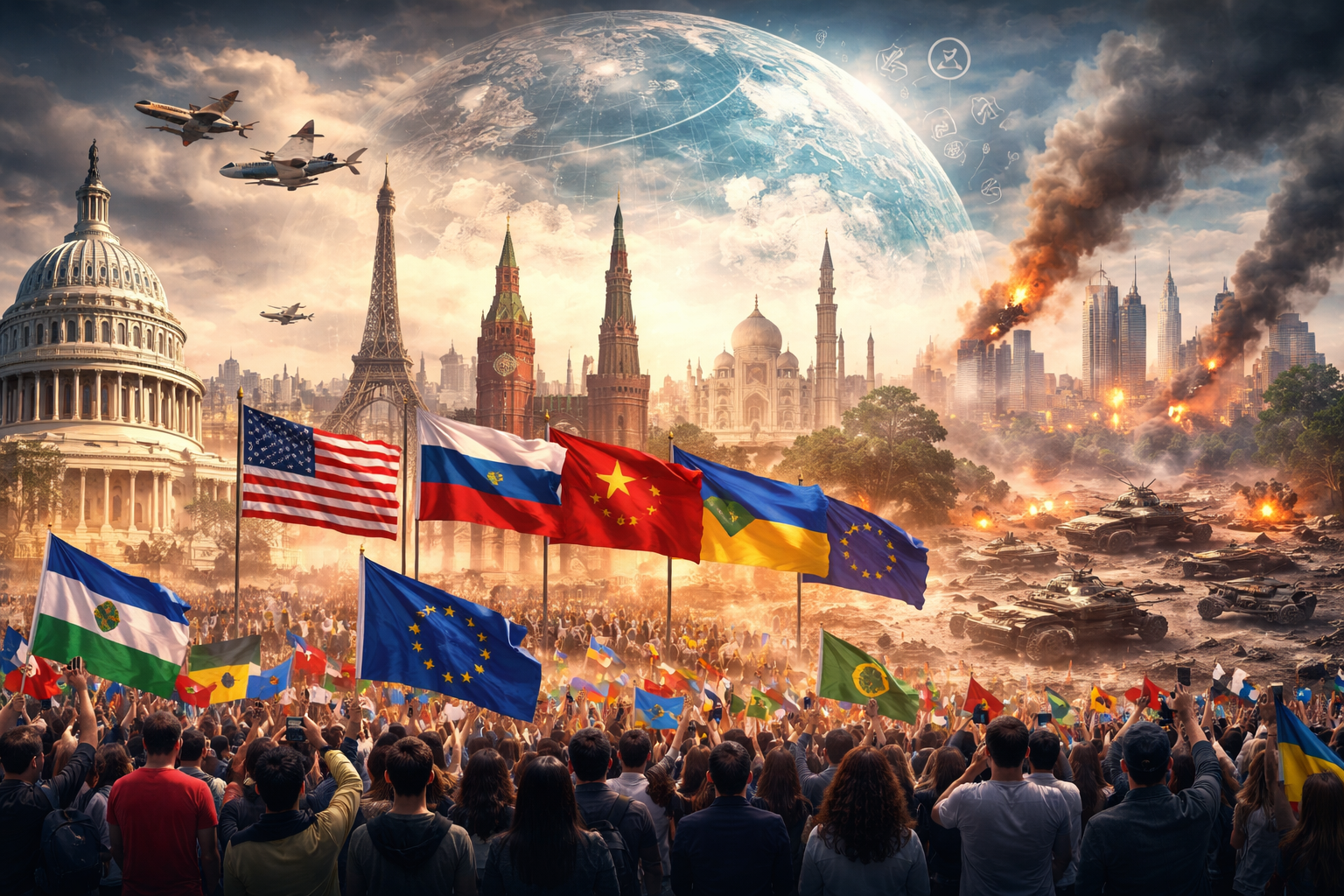
New Delhi / London: As the world enters 2026, global politics finds itself at a decisive inflection point. The shocks of 2025—ranging from intensifying trade wars and unresolved armed conflicts to economic volatility and accelerating multipolarity—have not subsided. Instead, they have reshaped the international system into something more fractured, more transactional, yet paradoxically more interconnected than ever before.
The year ahead promises a volatile mix of high-stakes elections, potential diplomatic openings, renewed geopolitical tensions, and deepening economic pressures. Old alliances are being tested, new blocs are asserting themselves, and the rules that governed the post–Cold War order continue to erode. While forecasting global politics always carries uncertainty, prevailing trends suggest that 2026 could either mark the consolidation of a new world order—or the deepening of global disorder.

At the heart of this transition lies a central contradiction: nations are increasingly divided by ideology, nationalism, and strategic competition, yet bound together by shared challenges such as climate change, artificial intelligence governance, supply-chain resilience, and nuclear risk. How leaders navigate this tension will define the political trajectory of the decade ahead.
Elections and Domestic Political Shifts: Democracy Under Global Strain
One of the defining features of 2026 will be the sheer scale of electoral activity worldwide. More than 20 countries are expected to hold national-level elections, making the year a major stress test for democratic institutions already strained by populism, misinformation, economic inequality, and declining public trust.
United States Midterm Elections (November 3, 2026)
The U.S. midterms will stand out as one of the most consequential political events of the year. Serving as a referendum on President Donald Trump’s second-term agenda, the elections will determine whether Republicans can maintain or expand their control over Congress.
Key issues are expected to dominate the campaign trail: aggressive tariff policies, immigration enforcement, border security, AI regulation, and the reshaping of federal institutions. While historical trends suggest the president’s party typically loses seats in midterm elections, Trump’s enduring approval ratings and his ability to energize a loyal voter base could disrupt conventional patterns.
A Democratic regain of the House would restore legislative checks on executive power and intensify investigations into trade, foreign policy, and governance. Conversely, a Republican sweep would embolden Trump’s transactional approach to diplomacy and deepen ideological polarization at home, with global ramifications for allies and adversaries alike.
Brazil General Elections (October 4; Runoff October 25)
Brazil’s general elections are poised to be a defining moment for Latin America. With President Luiz Inácio Lula da Silva stepping aside, voters will choose a successor in a sharply polarized contest shaped by economic inequality, environmental policy, and Brazil’s global alignment.
The ideological divide remains stark. Candidates aligned with the Workers’ Party advocate social welfare expansion, environmental protections—particularly in the Amazon—and stronger ties with China and the BRICS bloc. On the right, forces influenced by Jair Bolsonaro’s legacy emphasize market liberalization, skepticism toward climate regulations, and closer alignment with the United States.
The outcome will have global implications, not only for climate diplomacy but also for the balance of power within emerging economies and South–South cooperation.
Hungary Parliamentary Elections (Spring 2026)
After more than 15 years in power, Prime Minister Viktor Orbán faces mounting scrutiny. His Fidesz party’s illiberal governance—marked by media consolidation, judicial influence, and restrictive social policies—has repeatedly clashed with the European Union.
Growing voter fatigue, economic pressures, and opposition coordination could weaken Orbán’s dominance. A strong opposition showing may ease tensions between Hungary and Brussels, potentially stabilizing EU unity. However, another decisive Fidesz victory would further embolden nationalist movements across Europe and deepen ideological rifts within the bloc.
Israel Legislative Elections (By November 2026)
Israel may head to early elections amid persistent protests, unresolved war fatigue, and ongoing regional instability. Prime Minister Benjamin Netanyahu’s coalition remains under pressure over Gaza’s reconstruction, West Bank settlement expansion, and relations with Iran.
While a shift toward centrist or left-leaning forces could revive diplomatic engagement and reduce international isolation, political realities suggest right-wing dominance is likely to persist. Such an outcome would reinforce Israel’s hardline security posture and complicate U.S. and regional mediation efforts.
Other Key Electoral Battlegrounds
Beyond these headline contests, elections in Bangladesh, Sweden, Colombia, Peru, Ethiopia, Uganda, and Somalia will reflect shared global themes: economic distress, corruption scandals, youth-led demands for accountability, and the tug-of-war between populism and institutional stability.
Russia’s Duma elections, expected before September, are widely anticipated to reinforce the ruling United Russia party, with little space for genuine opposition. In Europe, the possibility of snap elections in countries like France underscores the volatility of domestic politics across advanced democracies.
Collectively, these elections are likely to produce fragmented outcomes, complicating governance at home and cooperation abroad.
Ongoing Conflicts and Security Challenges: A World Without Clean Endings
The security landscape of 2026 remains deeply unsettled, shaped by wars that refuse resolution and crises that continue to metastasize.
Ukraine–Russia: A Grinding War of Attrition
The war in Ukraine enters 2026 with no clear end in sight. Major territorial breakthroughs appear unlikely, and a frozen conflict along current frontlines is increasingly plausible. As U.S. military support becomes more conditional, Europe may be forced to assume greater responsibility for sustaining Ukraine’s defense.

While some analysts foresee the possibility of a ceasefire, any negotiated settlement is likely to favor Russia, raising profound concerns about sovereignty, deterrence, and the future of European security. Nuclear rhetoric, though largely symbolic, remains a persistent backdrop, heightening global anxiety.
Middle East: Fragile Ceasefires, Persistent Fault Lines
The Middle East remains a tinderbox. Gaza’s ceasefire is fragile, with humanitarian reconstruction slow and politically contested. Tensions along the Israel–Lebanon border, instability in Syria, and factional struggles in Iraq raise the risk of wider escalation.
Iran stands at a pivotal juncture. Economic strain, social unrest, and elite divisions could push the regime toward reform—or trigger harsher repression and instability. U.S.-led diplomatic efforts may seek regional de-escalation, but entrenched positions and domestic politics continue to limit breakthroughs.
Other Global Flashpoints
In East Asia, tensions over Taiwan are expected to intensify rhetorically and militarily, even as China avoids outright invasion in favor of sustained pressure and “grey-zone” tactics. In Africa’s Sahel, jihadist groups continue to expand amid weak governance, while Myanmar’s civil war grinds on with devastating humanitarian consequences.
Venezuela remains a wildcard, facing economic collapse and growing external pressure that could lead to regime change or renewed instability.
Compounding these risks is the erosion of global arms control. The expiration of the New START treaty leaves the U.S. and Russia—holders of nearly 90 percent of the world’s nuclear warheads—without a binding framework, raising fears of a renewed arms race.
International Relations and Global Summits: Multipolarity in Practice
The diplomatic calendar of 2026 reflects a world adjusting to multipolar reality. Power is no longer concentrated but dispersed among competing centers.
Key summits—including NATO, the G20, BRICS, APEC, and the UN High-Level Political Forum—will serve as arenas of contestation rather than consensus. NATO’s July summit will focus on defense spending and Ukraine, but transactional approaches to alliances may strain cohesion.
U.S.–China relations may stabilize tactically on trade while deteriorating strategically over Taiwan and technology. The European Union faces internal strain as populist movements challenge integration. Meanwhile, the Global South is asserting itself more forcefully, demanding greater influence in global governance.
India’s expanding role within BRICS and other multilateral forums highlights this shift, positioning it as a bridge between rival blocs.
Economics, Technology, and the Forces Reshaping Politics
Economic pressures will continue to fuel political volatility. Global growth is projected to slow to around 2.5–3 percent, weighed down by trade fragmentation and tariff escalation. Inflation, though moderated, remains politically potent, sustaining anti-establishment sentiment worldwide.
The race for technological dominance—especially in artificial intelligence—adds another layer of competition. While the U.S. retains advantages, China’s rapid advancements challenge long-held assumptions of Western supremacy. Governance of AI, cyber security, and data flows is fast becoming a central geopolitical issue.
Climate change remains the defining shared crisis. Climate negotiations, alongside developments in space exploration and even debates over unidentified aerial phenomena, reflect a world grappling simultaneously with existential risks and transformative possibilities.
Even global sporting events like the 2026 FIFA World Cup are unlikely to escape political overtones, underscoring how deeply politics now permeates global culture.
A Defining Year for a New World Order
In sum, 2026 stands as a year that may clarify the contours of a new global order—more transactional, more multipolar, and more volatile. Diplomatic breakthroughs remain possible but fragile, while the risks of escalation in Ukraine, the Middle East, and Asia loom large.
Ultimately, the direction of global politics in 2026 will depend less on ideology and more on pragmatism. As emerging powers assert influence and established powers reassess their roles, the world faces a stark choice: manage fragmentation through cooperation, or allow division to harden into lasting instability.
The resilience of global politics—and the societies it shapes—will be tested as never before.




 ---------------------------------------------------------------------------------------------------