New Delhi: 2025 emerged as one of the most testing yet defining years for India’s internal security and counter-terrorism architecture. The country confronted a complex web of threats ranging from cross-border terrorism backed by Pakistan-based outfits to homegrown radicalisation, white-collar terror modules, narco-terror financing, and the expanding footprint of global jihadist ideologies linked to ISIS and Al-Qaeda. While the year witnessed some of the deadliest terror incidents in recent times, it also showcased India’s growing operational maturity, intelligence coordination, and political resolve to adopt a zero-tolerance approach against terrorism.
From the blood-soaked valleys of Jammu and Kashmir to the heart of the national capital, terror groups attempted to strike fear and disrupt communal harmony. Yet, India’s security forces — led by the National Investigation Agency (NIA), state Anti-Terrorism Squads (ATS), intelligence agencies, and specialised police units — responded with decisive force, dismantling modules, neutralising operatives, and preventing catastrophic attacks.
A Year Marked by Major Terror Incidents
The year began with heightened tensions in Jammu and Kashmir, where infiltration attempts and encounters continued despite improved border surveillance. In March, a fierce gun battle in Kathua district resulted in the martyrdom of four police personnel, while two terrorists were eliminated. The incident underscored the continued presence of well-armed terror modules attempting to regroup in the region.
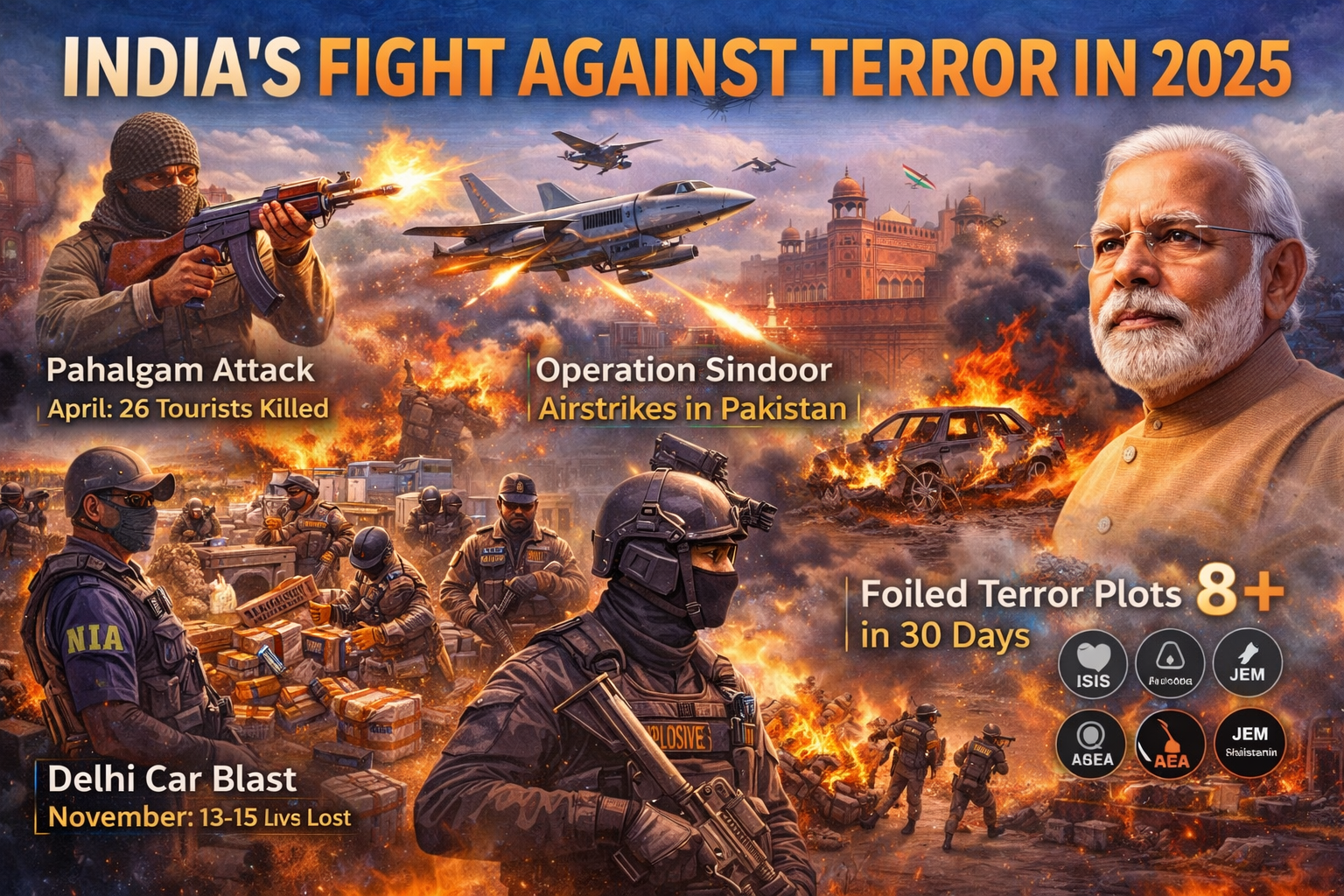
However, the most horrific attack of 2025 unfolded on April 22 in Pahalgam’s picturesque Baisaran Valley. Lashkar-e-Taiba (LeT) terrorists targeted a group of tourists, killing 26 civilians, including a Christian tourist and a local resident. The attackers reportedly verified the religious identities of their victims before opening fire, revealing a chilling communal intent. It was the deadliest civilian terror attack since the 2008 Mumbai attacks and triggered nationwide outrage, protests, and international condemnation.
In November, terror struck the national capital when a car bomb exploded near Delhi’s iconic Red Fort, killing between 13 and 15 people. Investigators later confirmed the use of ammonium nitrate and traced the conspiracy to a highly educated, “white-collar” terror module. Shockingly, the network involved radicalised professionals, including doctors from Kashmir, highlighting a dangerous new dimension of urban terrorism.
Other notable incidents included grenade attacks in Punjab, blasts in Haryana, and attempts at targeted killings, many of which were linked to Pakistan-backed Khalistani groups or jihadist affiliates operating through sleeper cells.
Intensified Operations and Mass Crackdowns
In the aftermath of the Pahalgam massacre, counter-terror operations intensified dramatically, particularly in Jammu and Kashmir. Security agencies conducted sweeping raids, leading to more than 2,800 arrests linked to overground workers (OGWs), terror facilitators, and sympathisers. While these actions disrupted terror logistics and recruitment pipelines, they also attracted scrutiny from UN human rights experts, who raised concerns over detentions under stringent laws such as the Unlawful Activities (Prevention) Act (UAPA) and the Public Safety Act (PSA).
Despite criticism, Indian authorities maintained that decisive action was essential to prevent further civilian casualties and dismantle entrenched terror ecosystems.
Key Module Busts Across India
Throughout 2025, Indian security agencies achieved remarkable success in dismantling terror modules across multiple states:
- Jammu & Kashmir–Haryana Module: Police busted an inter-state network linked to Jaish-e-Mohammed (JeM) and Ansar Ghazwat-ul-Hind, seizing nearly 2,900 kilograms of improvised explosive device (IED) material. Seven accused were arrested, including medical professionals, exposing deep-rooted radicalisation within educated circles.
- Punjab: The Punjab Police cracked down heavily on ISI-backed Khalistani networks. Over 12 major terror cases were solved, 19 modules dismantled, and 131 operatives arrested. Authorities also linked terror funding to massive drug seizures, highlighting the narco-terror nexus fueling violence in the state.
- Gujarat: The Gujarat ATS arrested Al-Qaeda operatives propagating the ideology of “Ghazwa-e-Hind.” Among those held was a software engineer who had received explosives training, underlining the sophistication of modern terror recruitment.
- Delhi: Delhi Police foiled a jihadi plot involving suicide bombings and targeted assassinations. Five radicalised youths, allegedly guided by handlers in Pakistan, were arrested before the plan could be executed.
- Southern and Western India: Andhra Pradesh police neutralised a JeM recruitment cell, while Maharashtra ATS arrested a tech professional linked to an Al-Qaeda-affiliated network. Telangana and Karnataka also reported ISIS-inspired arrests during the year.
Between October and November alone, security agencies foiled at least eight major terror plots within a 30-day period, including plans involving ISIS fidayeen squads in Delhi-Bhopal, Babbar Khalsa International (BKI) IED attacks in Punjab, and even a suspected chemical weapons attempt in Gujarat.
Operation Sindoor: A Strategic Turning Point
The defining moment of India’s counter-terror campaign in 2025 came with Operation Sindoor, launched in May following the Pahalgam massacre. In a bold and unprecedented move, India carried out precision airstrikes on nine terror camps located in Pakistan and Pakistan-occupied Kashmir (PoK). The operation reportedly eliminated over 100 terrorists and destroyed key training and logistics facilities of LeT and JeM.

Executed using indigenous weapon systems, including BrahMos missiles, Operation Sindoor marked a decisive shift in India’s counter-terror doctrine — from strategic restraint to proactive deterrence. The military action was accompanied by strong diplomatic measures, including border closures and suspension of trade, compelling Pakistan to agree to a ceasefire by May 10.
Home Minister Amit Shah described the operation as a message to both “planners and executors of terror,” signalling that India would treat terrorism as an act of war rather than a mere law-and-order challenge.
Institutional and Policy Advancements
Beyond kinetic operations, 2025 also saw significant institutional reforms. The Anti-Terrorism Conference-2025, inaugurated by Amit Shah, stressed the need for a unified national approach. Key focus areas included:
- Strengthening state ATS units
- Real-time intelligence sharing through the Multi-Agency Centre (MAC)
- Tackling the terror–crime nexus, particularly drug trafficking and money laundering
India also advanced work on its first comprehensive National Counter-Terrorism Policy, aimed at improving prosecution rates, choking terror financing, countering online radicalisation, and enhancing international cooperation.
The NIA led several high-profile investigations, including the Delhi Red Fort blast case, in which nine accused — most of them professionals — were arrested. Extradition efforts against wanted terrorists also gained momentum.
Technological upgrades became central to counter-terror efforts, with increased use of AI-driven surveillance, cyber monitoring, counter-drone systems, and joint training programmes with European Union agencies.
Regional Hotspots and Emerging Trends
- Jammu & Kashmir: While infiltration attempts declined due to better border management, hybrid terrorism persisted through OGWs and lone-wolf attackers.
- Punjab: Authorities remained on high alert against ISI-sponsored Khalistani revival efforts, especially targeted killings and grenade attacks.
- Mainland India: A worrying trend was the rise of “white-collar” radicalisation involving doctors, engineers, and students influenced via encrypted platforms and social media.
- Southern States: Andhra Pradesh, Telangana, and Karnataka emerged as new recruitment and logistics hubs for ISIS and JeM-linked groups.
Challenges, Criticism and the Road Ahead
Despite notable successes, India’s counter-terror journey in 2025 was not without challenges. Online radicalisation, urban soft targets, terror financing through drugs and cryptocurrency, and evolving tactics such as chemical weapon experimentation posed serious concerns.
Human rights organisations criticised mass detentions in Kashmir and alleged excesses such as “bulldozer justice.” Additionally, coordination gaps among over 20 intelligence and enforcement agencies highlighted the need for streamlined command structures.
2025 tested India’s resolve like few years before it, but it also demonstrated the country’s growing capability to confront terrorism with clarity and confidence. From preventing dozens of planned attacks to executing Operation Sindoor’s decisive strikes, India’s security forces saved countless lives through intelligence-led, technology-driven operations.
The dismantling of ISIS, Al-Qaeda, JeM, and Khalistani modules, combined with policy reforms and institutional strengthening, reinforced India’s zero-tolerance stance under Prime Minister Narendra Modi’s leadership. As terror threats evolve through digital radicalisation and proxy warfare, India’s proactive blend of force, diplomacy, and technology positions it strongly for the future — ensuring that the sacrifices of 2025 translate into lasting national security.