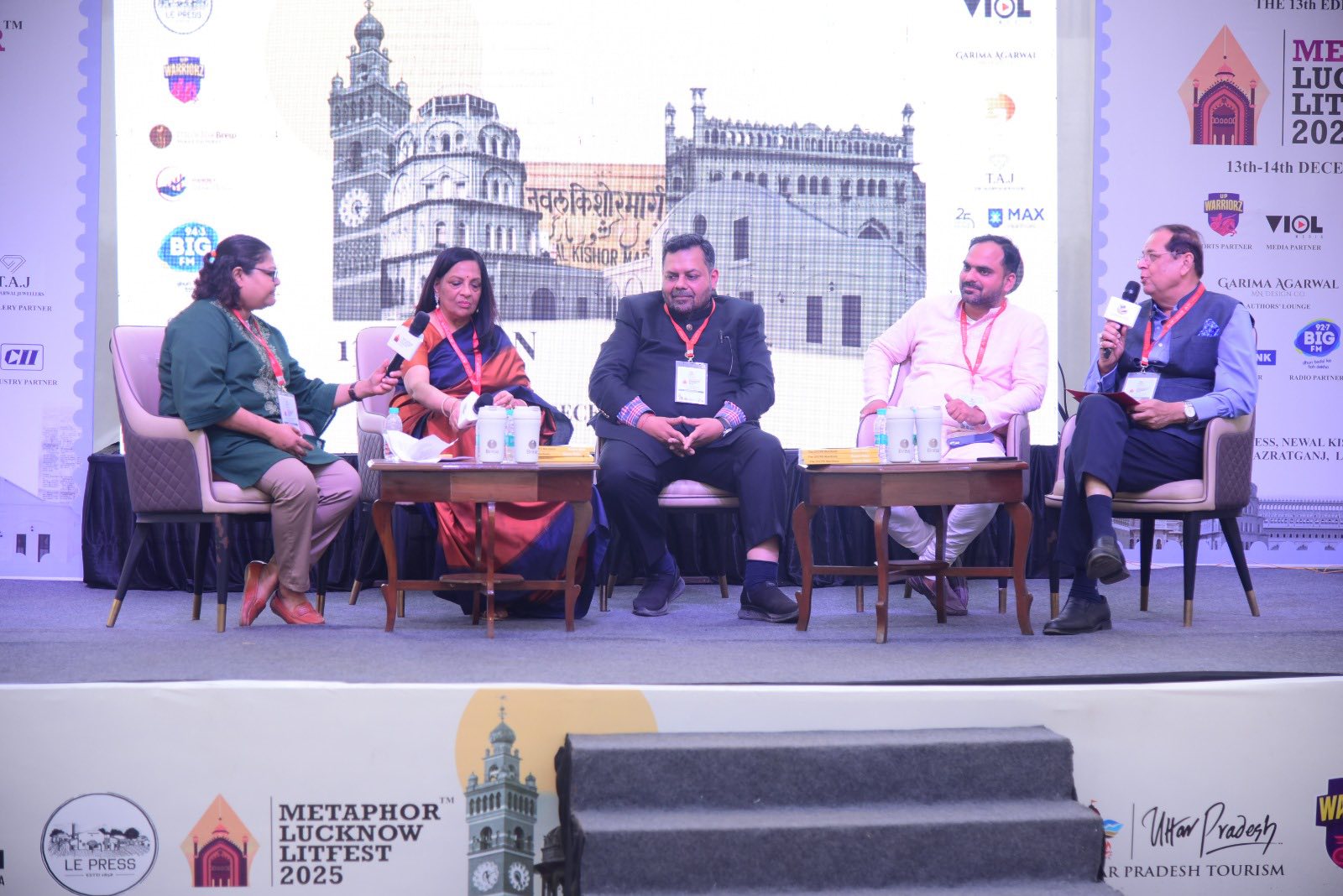
Lucknow: Metaphor LitFest hosted an illuminating session titled “Munshi Naval Kishore: A Legacy Reignited”, featuring Nita Dube, Himanshu Bajpai, Chander Prakash, Amina Hasan, and Gaurav Vatsa. The panel traced the remarkable journey of Munshi Naval Kishore—publisher, nationalist, entrepreneur, and one of India’s foremost custodians of knowledge.
Chander Prakash opened the session, reflecting on the honour of revisiting a legacy he grew up with. Nita Dube narrated Munshi ji’s early life: born in a small village, educated by a learned grandfather, and trained in Hindi, Urdu, Sanskrit, and Persian. At 15, Naval Kishore contributed to Sabeer-e-Agra and later apprenticed under Harsukh Rai of Kohinoor Press in Lahore, earning the title “Munshi” for his dedication. After the 1858 Mutiny, he founded his own press in Lucknow at a time when skilled calligraphers, translators, and printers faced scarcity of work. With just two lithostones, a hand press, and boundless vision, he laid the foundations of what would become one of Asia’s largest publishing institutions.

Over his lifetime, Munshi ji published nearly 5,000 works spanning astrology, astronomy, literature, medicine, and more—transforming his press into a “one-man national library.” By vertically integrating production, he reduced costs, making knowledge accessible to the common man. The Upper India Book Mill further expanded this mission. He translated Urdu and Arabic texts into Hindi and Sanskrit, and vice versa, enabling rich cross-cultural literary exchange.
Munshi ji also played a subtle yet pivotal role in India’s freedom movement. Joining the Indian National Congress in 1888, he published nationalist ideas and used the Awadh Akhbar to challenge colonial authority, navigating the restrictions of the Vernacular Press Act. Himanshu Bajpai, whose PhD research focuses on the Naval Kishore Press, highlighted landmark works like the 46,000-page Dastan-e-Ameer Hamza, noting that the press was central to shaping both national consciousness and the literary imagination of North India.

Architect and restorer Gaurav Vatsa detailed the revival of the historic press building, retaining its three-brick-thick walls, preserving surrounding trees, and restoring structural elements by hand using minimal resources. He emphasised that LePress is not merely a name but a cultural revival. Plans for a museum and VR experience aim to showcase the original press, ensuring the heritage lives on for future generations. “When the world wants everything new, we must show how to preserve the old,” he said.
Amina Hasan, curator of archival materials, described the painstaking effort to restore manuscripts—many damaged by termites, moisture, or age. She explained the cleansing rituals observed before handling sacred Hindu, Muslim, and other texts, calling the effort “a secular act of cultural devotion.” She shared stories of retrieving manuscripts from trunks, aided by Nita ji’s house-help, Pooja, and even her dog, Onyx. Hasan urged the public to share any surviving original works of the Naval Kishore Press, noting that many preserved copies are held in collections at Heidelberg and Oxford Universities.
The session concluded with reflections on how Lucknow’s cultural identity, collective memory, and spirit of coexistence endure through Munshi Naval Kishore’s work. Chander Prakash summed it up: “This is not just history—it is a proud memory being reignited.”