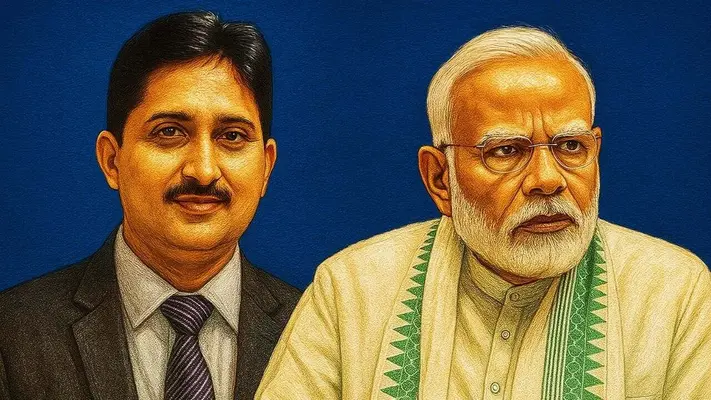
New Delhi: In the labyrinthine corridors of Indian power—where access is currency, silence is strategy, and influence often wears an invisible cloak—few figures command as much mystique as Hiren Joshi. At 54, the Officer on Special Duty (OSD) for Communications and Information Technology in the Prime Minister’s Office (PMO) wields an authority far exceeding his joint-secretary-level designation. For more than a decade, Joshi has remained the unseen hand behind the country’s most meticulously crafted political messaging, a shadow strategist whose fingerprints touch everything from the Prime Minister’s multilingual tweets to the choreography of high-octane digital offensives.
In an era where the battleground of politics has shifted from street corners to smartphones, Joshi stands as the architect of Narendra Modi’s digital fortress: the man who shapes perceptions, anticipates storms, and neutralises threats before they erupt. To understand how this soft-spoken electronics engineer from Rajasthan came to be regarded as Modi’s “media motherboard,” one must travel back to the dusty lanes of Bhilwara, where the first seeds of ideological alignment and technological curiosity quietly took root.

The Making of a Technocrat
Born in the mid-1970s in Bhilwara—a textile town wrapped in the philosophical quiet of Rajasthan’s heartland—Joshi grew up in a family steeped in the Rashtriya Swayamsevak Sangh (RSS) ethos. The organisation’s disciplined routines and nationalist worldview formed the scaffolding of his youth, creating a natural alignment with Modi’s ideological universe long before their paths crossed.
Academically gifted and introspective, Joshi left Bhilwara for Pune to pursue electronics engineering, immersing himself in the technological currents of the 1990s. His drive propelled him further: he earned a PhD from IIITM Gwalior, specialising in systems analysis and communication technologies. Long before terms like “algorithmic warfare” and “digital influence operations” became fashionable, Joshi was studying the interplay of data, systems and behaviour—an intellectual foundation that would later prove prophetic.
By the early 2000s, he had settled into academia as an assistant professor at Manikya Lal Verma Textile and Engineering College, teaching electronics and communication engineering for nearly two decades. Students recall a precise, methodical teacher—a man more comfortable with circuit boards than crowded seminars, someone who preferred the logic of machines to the noise of politics. But his colleagues also remember his side interest in software development, often spending nights debugging analytics tools and building time-management applications. Joshi didn’t yet know it, but he was prototyping the digital instruments that would one day fuel Modi’s political machinery.
The Chance Encounter That Changed Everything
The defining pivot in Joshi’s life came in 2008, during a seemingly mundane technical glitch in Gandhinagar. Narendra Modi, then Chief Minister of Gujarat, was hosting a high-profile event when a sudden equipment failure stalled proceedings. Accounts vary—some say it was a projector malfunction, others cite audio failure—but what is uncontested is the brisk, near-surgical intervention of Joshi, then in Gujarat as a visiting consultant.
Modi, known for his intolerance of inefficiency, was impressed. And in that moment, a door opened: Joshi was invited to join the Chief Minister’s Office as an OSD, tasked with a fledgling experiment—digitising Modi’s public persona.
Social media at the time was embryonic in Indian politics. Twitter was a curiosity; Facebook still felt like a campus tool. But Joshi saw potential. He built Modi’s digital infrastructure from scratch, overseeing blogs, websites and the first wave of social media accounts. He guided the translation of Modi’s speeches into regional languages and introduced custom software to streamline governance, eliminate redundancies and analyse public outreach. It was governance by metrics—an approach that would later define Modi’s national leadership style.
From Gujarat’s Backrooms to Delhi’s War Rooms
When Modi began his ascent to Delhi in 2014, Joshi and his Gujarat media cohort migrated with him. Inside the PMO, Joshi’s influence deepened, his portfolio expanding far beyond communications. His daily briefings to Modi—trending hashtags, political rumblings, grassroots sentiment—became indispensable. He sifted social media chatter for signals, elevated praise, filtered criticism and fed Modi’s strategic instincts with precision-curated insights.
“He’s the Prime Minister’s eyes and ears,” a South Block insider remarked to Open magazine, describing his near-constant vigilance.
It was under Joshi’s stewardship that digital campaigning turned into a fine art—where algorithmic mastery met psychological insight. During the 2019 elections, the nationalist wave following the Balakot strikes was magnified through digitally orchestrated messaging. In 2024, the “vishwaguru” narrative—casting Modi as India’s global statesman—was sharpened through targeted online campaigns, multilingual posts and quick-response content factories. If Modi was the face, Joshi was the frame.
The Super-Editor in the Shadows
Veteran journalist Rajdeep Sardesai, in his book 2024: The Election That Surprised India, refers to Joshi as the “third most important person in the Modi government,” describing him as a “super-editor” who shapes the tone and texture of India’s political discourse. Sardesai narrates anecdotes of TV networks receiving “suggestions” through encrypted channels—gentle nudges that often became editorial mandates. Stories that flattered Modi were amplified; those that challenged him quietly shrank from prominence.
Channel heads, editors and anchors learned to read between the lines. An adverse headline could trigger calls; a critical panel might invite a quiet reprimand. Joshi’s influence, insiders say, was not crude coercion but subtle recalibration—steering narratives rather than dictating them aloud.

His oversight extended beyond mainstream media. Digital campaigns after Pulwama, during LAC tensions, and through numerous diplomatic flashpoints often bore the unmistakable imprint of coordinated messaging. Troll armies, critics allege, were mobilised on cue; hashtags emerged and disappeared with algorithmic synchronisation.
An Untouchable Insider—And the Secrets He Keeps
What makes Joshi’s influence exceptional is not only its breadth but its insulation. Unlike ministers or party officials who ebb and flow with election cycles, Joshi’s position rests on a foundation of trust, ideological symmetry and a decade-long fidelity to Modi.
Journalists recount failed attempts in 2025 to remove him, citing his encyclopaedic knowledge of Modi’s working style and political instincts—insights so intimate they render him difficult to dislodge. One insider described him as a “vault”—a custodian of secrets whose departure could shake the system.
Joshi himself rarely speaks in public. He avoids interviews, declines profiles, and keeps a low social presence. His first known public photograph appeared only in 2024, at the G20 Summit. His authority is quiet, exercised through whispers rather than proclamations.
The Controversies That Follow His Rise
Power, especially of the invisible sort, inevitably breeds suspicion. Opposition parties have often portrayed Joshi as the fulcrum of what they call the BJP’s “media capture.” Arvind Kejriwal accused him in 2022 of throttling coverage of the Aam Aadmi Party, pressuring channels and intimidating anchors. In December 2025, Congress spokesperson Pawan Khera dramatically labelled him the “H-bomb,” alleging he had “murdered democracy” by suffocating the free press. Khera demanded probes into alleged foreign connections, meetings in the U.S. and supposed ties with BJP financier Hitesh Jain—charges that remain unproven but continue to swirl in Delhi’s rumour mills.
The speculation spiked in late 2025 when Joshi briefly vanished from internal PMO WhatsApp groups where daily “media guidance” was typically shared. Rumours of his ouster spread quickly, amplified by the concurrent resignation of Prasar Bharati chief Navneet Sehgal. Hashtags speculating on Joshi’s fall trended across platforms.
But the suspense was short-lived. On December 4, Joshi reappeared in PMO communication channels, quashing dismissal theories but fuelling new speculation about internal tensions. “He won the battle,” a National Herald source remarked, hinting yet again at the depth of his embedded influence.
The Blueprint of Modi’s Narrative Machine
To understand Joshi is to understand Modi’s governance style: a leadership built on meticulous message discipline, rapid response systems, and an overarching narrative that merges ideology, technology and emotion. Where Home Minister Amit Shah strategises elections and National Security Advisor Ajit Doval shapes covert operations, Joshi operates in a more nebulous domain—controlling perception itself.
He occupies the ether: the space between information and influence, between digital noise and political momentum. His journey from a Bhilwara classroom to Delhi’s power chambers represents the BJP’s evolution from a traditional cadre-based party to a technologically augmented political machine.
The Legacy of an Invisible Powerbroker
As India moves toward the next general election, Hiren Joshi remains one of the most consequential yet least understood figures in the Modi era. His silhouette lingers in the background of rallies, speeches, international summits and moments of crisis. He is the curator of the Prime Minister’s digital self, the sentinel guarding his narrative, the strategist fine-tuning national discourse from behind a veil.
Joshi’s influence, much like his persona, is elusive—felt but not seen, heard but not acknowledged. Whether viewed as a loyal custodian preserving a leader’s image or a controversial gatekeeper constricting democratic debate, his impact on India’s political communication is undeniable.
In the end, his enigma is his power. For in politics, the most formidable influence is often wielded not by those who seek the spotlight, but by those who master the shadows.