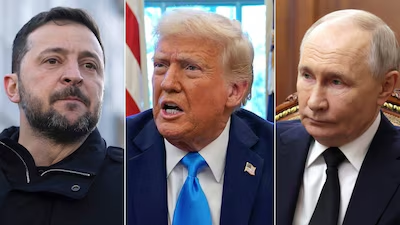
Donbas serves as a launching pad for a potential fresh onslaught by the Russians. “We will start a third war if we leave Donbas on our own initiative or under duress,” Zelenskyy warned reporters. “Because I have no right to do so, I will not give up my nation. We will undoubtedly provide a bridgehead for the planning of a Russian attack if we abandon Donbas today, together with our defenses, our landscape, and the heights under our control.”
The Donetsk and Luhansk areas of Ukraine make up the Donbas, which is short for “Donets Basin.” It is the industrial and mining hub of the nation, renowned for its dense metropolitan areas, steel manufacturing, and superior coal deposits. Approximately one-third of Ukraine’s population lived in the area prior to the conflict.
The region extends from the Russian border in the north to Mariupol in the south. All of Luhansk and a big portion of Donetsk are now under Russian administration, along with sizable portions of Zaporizhzhia and Kherson, little areas of Kharkiv and Sumy, and Crimea, which Moscow seized in 2014. About 30% of Donetsk is still in Ukrainian control, including strategically located high ground and well-constructed defense lines. Over 200,000 inhabitants reside in this region, which is still under Ukrainian authority.
Putin’s Desires
Vladimir Putin, the president of Russia, is calling on Ukraine to remove its forces from the 9,000 square kilometers of Donetsk that are still governed by Kyiv. According to European sources quoted by The New York Times, Moscow’s overarching negotiation stance is for Ukraine to completely withdraw from the Donbas, therefore ceding the remaining portion of Donetsk and establishing Russia’s authority over the whole of Luhansk, which is already completely under Russian military occupation.
In addition to securing the region, such a concession would provide Moscow a more solid foothold from which to conduct operations in central Ukraine in the future.
Red Lines of Zelenskyy: Concerns About a “Third War”
Zelenskyy has maintained that Ukraine must be actively involved in any territorial negotiations. “We cannot have any fruitful discussions without [Ukraine] at the table. “They are feasible, but we won’t accept them,” he said.
Additionally, he has issued a warning that Russia’s present army buildup may serve as the precursor to a new attack as early as September. “I have not heard anything—not a single proposal that would ensure that Putin won’t attempt to occupy at least Dnipro, Zaporizhzhia, and Kharkiv, and that a new war won’t break out tomorrow,” he said.
According to the Ukrainian president, any geographical compromise would just postpone, not stop, the next Russian attack in the absence of legally valid and enforceable security assurances, which he claims are now only provided by Europe.
The Role of Trump and the “Land Swap” Concept
Trump has said time and time again that a peace agreement between Russia and Ukraine may be based on a negotiated territory swap. He said that the war may end with “some swapping of territories” after announcing his meeting with Putin. What, if anything, Russia would give up in such an agreement is yet unknown.
According to reports, the White House is attempting to persuade European leaders to support the plan, a move that detractors claim would enable Putin to proclaim triumph while putting Kyiv’s accomplishments in doubt. Trump has said that he would update Kyiv and European leaders after the discussions on Friday, but Zelenskyy has not been invited. Making a contract is not my responsibility. For both, I believe a settlement should be struck. I will disclose it to President Zelenskyy, the leaders of NATO, and the European Union if it is a fair arrangement. I may reply, “good luck, keep fighting,” or “we can work out a deal.”
A one-on-one meeting between Trump and Putin is “part of the plan,” according to White House press secretary Karoline Leavitt, who also called the Alaska encounter a “listening exercise.”
The Military Importance of Donbas
Ukraine’s defense has historically revolved around the Donbas. The area saw some of the fiercest combat on the Eastern Front during World War II. The contemporary conflict started in 2014 when Moscow-backed rebels took over sections of Donetsk and Luhansk after Russia unlawfully invaded Crimea. This led to a low-intensity combat that lasted for years. In February 2022, this turned into a full-scale Russian invasion.

Cities like Bakhmut and Avdiivka developed into strongholds where Ukrainian soldiers maintained the line throughout both stages of the war, severely damaging Russia. Since the first year of the full-scale invasion in 2022, these are still the only significant cities that Moscow has taken.
One north-south route connects the Ukrainian-held areas of Donetsk, creating a military barrier that prevents Russian troops from moving further west. Losing these posts “would effectively mean the collapse of this entire defensive line,” said Serhii Kuzan, head of the Ukrainian Security and Cooperation Center.
Moscow would also gain control of expensive defenses, essential railroad infrastructure, and coal and mineral-rich areas if Donbas were ceded. According to the Washington-based Institute for the Study of War, the vast terrain that exists beyond the industrial belt serves as a doorway to Ukraine’s heartland and is thus a perfect place to stage future offensives.
Additionally, the Donbas is a component of Ukraine’s “fortress belt,” a network of fortified settlements that has defied Russian incursions for more than ten years, including Kramatorsk and Sloviansk. It connects to routes that provide Russia access to the Black Sea, which has long been a top geopolitical objective for Moscow.
Kyiv’s Political Reality
Beyond the battlefield, however, national identity, public opinion, and the law all influence the conflict over Donbas. These limitations are reflected in Zelenskyy’s unwillingness to entertain a land-for-peace agreement. The president of Ukraine is not allowed to cede any portion of the nation’s territory in accordance with the Constitution. His perspective is also supported by public opinion: according to Serhii Kuzan, almost three-quarters of Ukrainians are against exchanging territory for peace, with resistance among the military being “much, much higher.”
The idea of “nothing about us without us,” which has its roots in Cossack-era customs of self-governance and group decision-making, is fundamental to Ukrainian identity, historian Yaroslav Hrytsak told NYT. He said that many members of the public would see any deal that was made without Kyiv’s direct involvement as being illegitimate.
Why Moscow May Prefer Discussions to Combat
For Russia, negotiations might accomplish in a matter of months what years of expensive conflict could otherwise take. Although Russian progress has accelerated lately, “even though they are making ground, it would still take years (three or more) at current rates to capture all this territory,” Matthew Savill, director of military sciences at the Royal United Services Institute, told Sky News.
A negotiated transfer of Donbas is an alluring shortcut for the Kremlin because it offers the possibility of accomplishing via diplomacy what may require years of combat, at the expense of significant deaths and resources.
The negotiations “certainly won’t create peace, but it might create a ceasefire in place if Putin decides to be flexible,” military expert Michael Clarke told Sky News. But he cautioned, “So far he hasn’t shown any flexibility at all,” and implied that Putin may use any truce to halt operations, bide his time politically, and launch the invasion again when favorable circumstances, like a change in US leadership, arise.
The Risks Associated with Alaska
Kyiv sees the moral and geopolitical justifications for refusing to cede Donbas. From a military standpoint, such a compromise would provide Moscow reinforced positions and vital transportation connections, remove the defensive lines that have impeded Russia’s progress, and clear the path to Ukraine’s heartland. Politically, it would violate the bounds of the constitution and go against the vast majority of people, putting any Ukrainian government that accepted it at risk of losing its legitimacy.
Additionally, there would be significant humanitarian repercussions: hundreds of thousands of civilians could have to leave the areas of Donbas that are controlled by Ukraine.
The future of Donbas is at stake as Trump and Putin get ready to meet in Anchorage, but Zelenskyy is certain that Ukraine must be included in any decision on it.