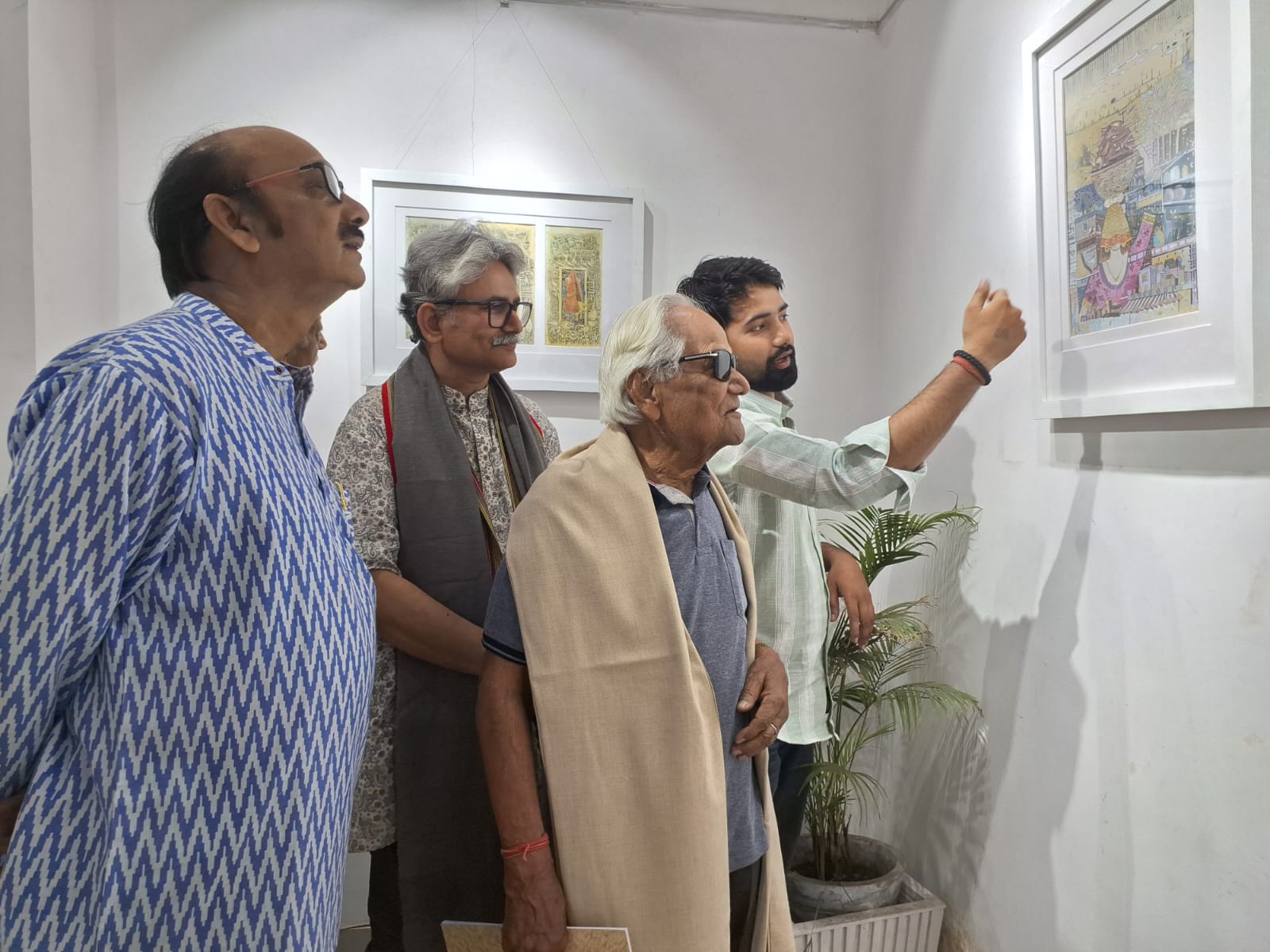
Kanpur – The ‘Madai’ (a traditional rural dwelling) exhibition by young artist Sumit Kumar from Aligarh was inaugurated today at the Gurukul Kala Vithika by senior theatre artist Radheshyam Dixit, who lit the ceremonial lamp. The exhibition is a joint initiative of Kala Deergha International Visual Arts Magazine and Gurukul Kala Vithika, Kanpur. During the opening session, a booklet based on Sumit Kumar’s latest works was also released by the guests.
Observing the exhibition, Chief Guest Radheshyam Dixit remarked that these works are “word-pictures.” He stated that Sumit Kumar has brought to life through his paintings the experiences of childhood and life that many have lived and were gradually forgetting. For a moment, he added, they were transported back to their childhood and the world from which they entered the world of art.
On the occasion, Sumit Kumar honored the Chief Guest Radheshyam Dixit, Acharya Abhay Dwivedi (Kul Guru, Gurukul Kalacharya), Dr. Awdhesh Mishra (Editor, Kala Deergha magazine and art scholar), and Dr. Leena Mishra (Curator of the exhibition) by presenting them with ‘ang vastra’ (a traditional shawl) and ‘baal vriksh’ (a sapling). Sumit expressed his gratitude, saying that he has imbibed the dedication towards art, the eagerness to nurture disciples, and the unique qualities of his guru, Dr. Awdhesh Mishra, which are now reflected in his artworks.
Senior Kanpur artist Dr. Hriday Gupta described Sumit as an energetic and soft-spoken artist, whose sensitivity is evident in his art. Dr. Anita Verma, the coordinator of the exhibition, shared that she has known Sumit since his student days and that his equal interest and dedication in painting, display, and coordination set him apart from his contemporaries.
Many art enthusiasts from Kanpur city, including Randhir Singh, Deepa Pathak, Dr. Mithai Lal, Ajay Pathak, Abhishek Pathak, Gopal Khanna, Neetu Sahu, Prashant, Neha Mishra, Abhinay Prakash Singh, Adhyatma Shivam Jha, and Radheshyam Pandey, were present at the opening. Acharya Abhay Dwivedi announced that the exhibition will remain open for art lovers for the next three days.
Discussing the theme and thought process behind Sumit Kumar’s exhibition, Dr. Leena Mishra, the curator, said that Sumit Kumar’s dedication to art and his guru, along with his sense of duty, has propelled him far at a young age. She noted the continuity in his work and believes he has a long way to go. The subjects of his paintings resonate with art connoisseurs.

Dr. Mishra elaborated on the significance of ‘Madai’, stating that in India’s rural culture, it is not just a roof made of grass and thatch providing shelter to both the common and the special; it is a vital corner of family and social life, and an emotional and cultural shield. It is where lives and values are shaped, and where the threads of culture woven through generations and the origins of traditions are found. ‘Madai’ is not only a symbol of traditional rural craftsmanship but also represents the efficiency, judicious use of resources, and environmental sensitivity of our ancestors. In rural life, it is commonly known as ‘chhappar’ (thatched roof) or, when enclosed with ‘tatti’ (bamboo screens) and plastered, as ‘jhopdi’ (hut), and as the ‘home of dreams’ for daily wage earners. It has been, and in many ways still is, an important part of the harmony with nature and the lifestyle before urbanization. Because it is not just a residential option but also a symbol of our cultural, social, and environmental values, this is the core sensibility of the young artist Sumit Kumar’s paintings.
Coming from a village in Aligarh, Sumit Kumar has a deep connection with the physical aspects of rural life, which is its most prominent and attractive feature. Rivers, streams, undulating and fertile-barren land, farms, cattle, and other natural resources have been integral to his life. The majority of the rural population is engaged in agriculture, which is the main basis of their lives. Homes have simple structures and minimal needs, with mud walls and tiled roofs, and ‘baithka’ (sitting areas) with thatched roofs. Although urban influences are now visible there, the rural life reflected in Sumit’s art and creativity is that of the old village, where interconnected houses of extended families or a beautiful house built a little away from the village in search of peace, a well, a temple, a barn, a garden adorned with flowers and leaves, and the beauty of the surrounding fields enrich life. The availability of water in rural areas is also natural and crucial, with most villages drawing water from rivers, reservoirs, or wells. Canals, ponds, wells (Rahat – Persian wheel), and now tube wells maintain the vibrancy of life for irrigation. The rural economy is based on agriculture, with people primarily cultivating paddy, wheat, sugarcane, oilseeds, and fruits and flowers, which is not only a means of livelihood but also an integral part of rural culture, and all related activities and festivals are implicitly present in Sumit Kumar’s art.
Sumit’s family is deeply rooted in Sanatani (Hindu) traditions, and he has been nurtured in the same environment. This is why Sumit does not tire of returning to these themes, nor does he bore his art lovers. He presents himself to the audience each time with innovation and a childlike wonder. He does not come out of his childhood, and indeed, who truly wants to leave childhood behind! Some want to relive their childhood in their children or grandchildren, and Sumit wants to live it in his creations, which appeal to art lovers of all ages and tastes.
Sumit Kumar is a sensitive young artist who yearns to live life with his surroundings, traditions, and the ideals and values shown by his elders. He lived his childhood and adolescence in a village, participating enthusiastically in rural life and activities – farming, barns, fairs, playing with childhood friends – and now, he has become serious, wanting to hold onto what is slipping away, to relive the expansive scenes of trees, mountains, and the music of animals and birds. He wants to hum those ‘childhood tunes’ with his childhood friends. That is why he remembers those colors that were fading in the hustle and bustle of life and wants to capture that ‘Madai’ and its culture, where Sumit bunked school, fixed the TV antenna to watch Ramayana and Mahabharata, listened to evergreen songs on the radio, cranked the handle of the pumping set in the fields, got his pajamas caught in the bicycle chain… and much more that his paintings hum about.
The ‘Madai’ and the life around it come alive in Sumit’s paintings in many forms – elderly couples supporting each other, childhood friends sitting on each other’s backs to pluck mangoes from a neighbor’s orchard, children herding buffaloes while riding on their backs, children tossing each other, several children sitting behind each other on a wooden horse or a makeshift train, children playing flutes and spinning tops at the fair, a householder weaving a cot, a housewife grinding spices or wheat, a small child sitting in front of a man carrying goods on a bicycle, a bioscope show, a balloon and ice cream vendor, a child riding a pair of scissors attached to a bicycle with another child squatting on the carrier, a child bathing under a hand pump, whether it’s mother’s kitchen or father’s bullock cart, a bride departing or street performers showing the dance of a monkey and its handler, or children bursting firecrackers – sparklers and spinning wheels – during Diwali, and countless other enchanting moments lived in childhood that we have left behind. In these paintings, there is the game of ‘ice-pice’ played in the shelter of the ‘Madai’, and in the ‘bakhar’ (storage pit) kept in the haystack, there is grain preserved for the donations to ascetics and the welcome of guests. There are countless colors of rural culture in Sumit Kumar’s art that are impossible to see at this age. It can only be said that this is the result of Sumit Kumar’s dedication, hard work, and the skillful guidance of his guru, Dr. Awdhesh Mishra, due to which he has become noteworthy in the art world for his choice of subject, narrative style, innovation, and skillful handling of the sensitive textures of rich colors.