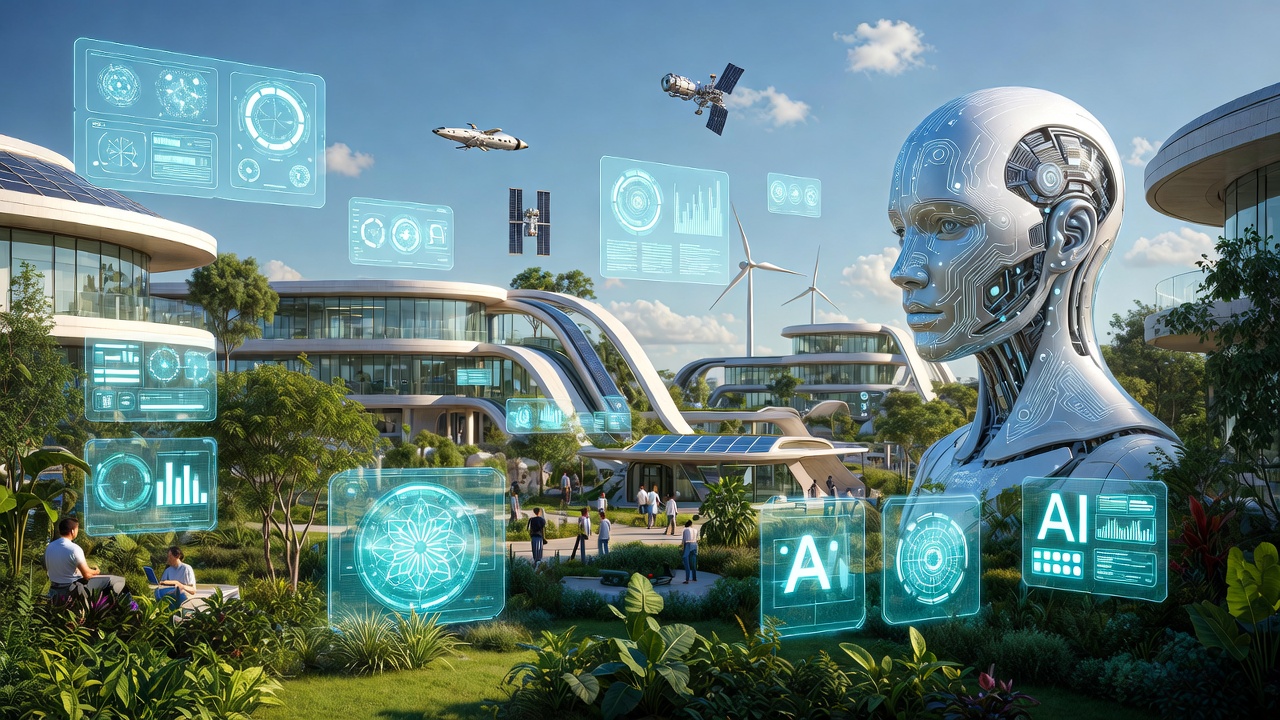
New Delhi: 2025 was a transformative year for technology, marked by rapid advancements across artificial intelligence (AI), hardware, space exploration, biotechnology, cybersecurity, and sustainable solutions. Amid ethical debates, regulatory shifts, and global collaborations, technology continued to reshape industries, economies, and daily life. From Google’s breakthroughs in AI to NASA’s space milestones, the year blended groundbreaking inventions with practical applications. According to McKinsey’s Technology Trends Outlook 2025, AI, advanced computing, and green tech drove unprecedented investment, pushing global tech spending past $5 trillion.
Popular Science highlighted 50 key innovations, emphasizing efficiency gains in aerospace and beyond, while the World Economic Forum spotlighted game-changers such as structural battery composites and engineered living therapeutics. This recap examines the major developments shaping 2025, drawing from industry reports, breakthroughs, and emerging trends.
AI Advancements: From Reasoning to Real-World Integration
AI dominated 2025, moving from hype to tangible impact. TIME magazine highlighted five key developments, including China’s rise in open-source AI and humans forming deeper relationships with AI companions.
OpenAI’s ChatGPT-5, released in August, advanced reasoning capabilities, while Google’s Gemini 3 and Gemma 3 models improved multimodal processing and efficiency. According to the Stanford AI Index 2025, AI systems generated high-quality videos, outperformed humans in specific tasks, and led the way with language model agents.
McKinsey’s State of AI Global Survey reported that 65% of organizations now use AI in strategy, talent management, and operations. Trends included multimodal AI for contextual understanding, AI agents evolving into multi-agent systems, and emphasis on testing and customization to manage risk.
IBM predicted a shift toward open-source large-scale models and smaller, efficient systems, enabling enterprise experimentation, while Morgan Stanley highlighted AI reasoning, custom silicon, and cloud migrations as drivers of innovation and ROI. Google Cloud noted AI’s increasing role in government, from predictive analytics to personalized citizen services.
Ethical debates intensified, focusing on AI-generated content watermarking and bias mitigation, becoming central to policy discussions. AI tools, including AI-powered copilots, improved workplace efficiency, reducing administrative tasks by up to 40%.
Hardware Innovations: Powering the Next Generation
Hardware technology focused on AI enablement and sustainability. Deloitte’s Tech Trends 2026 (previewing 2025 impacts) highlighted edge computing, quantum hybrids, and adoption acceleration. HackDiversity showcased on-device AI chips, neuromorphic processors, and AR smart glasses reshaping consumer experiences.
Gartner’s Top 10 Strategic Technology Trends for 2026 emphasized agentic AI and post-quantum cryptography. Arm’s innovations in datacenters and automotive enabled efficient edge AI, while eG Innovations noted 14 IT trends integrating AI improvements, automation, and personalized services. Kellton predicted 80% of companies adopting AI-driven tools by year-end.
ABI Research highlighted smart rings, humanoid robots, and green hydrogen tech, while the WEF featured structural battery composites and osmotic power systems. Together, these innovations reduced device energy consumption by 30%, paving the way for ubiquitous computing.
Space Technology: Milestones and New Frontiers
2025 marked a new golden age of space exploration. NASA celebrated 25 years on the ISS and advanced Artemis missions, while Lockheed Martin outlined AI/ML for autonomous operations and laser-based communication systems.

Interesting Engineering highlighted plasma engines reducing Mars travel time and blueprints for interstellar ships, while World Space Week showcased technologies for “Living in Space,” including habitats and life-support systems. WEF named 12 transformative space technologies, from advanced earth observation to BioSuits and space-based solar power.
Private lunar missions, satellite analytics, robotics, and propulsion systems advanced rapidly, and The Space Report Q2 projected growth in a global space economy exceeding $613 billion. Milestones included China’s lunar sample returns and SpaceX Starship tests, accelerating commercialization.
Biotech and Health Tech: Revolutionizing Medicine
Biotech and health tech flourished amid regulatory turmoil. STAT News and Physics World highlighted vision-restoring implants, quantum diagnostics, and off-the-shelf cell therapies. CRISPR and mRNA vaccines drove innovation, while AI converged with biotech to enable personalized medicine.
Telemedicine, wearables, diagnostics, and robotics saw strong growth, with notable breakthroughs including long-acting HIV medications and GLP-1 drugs for obesity. Despite AI’s slow penetration in health tech, digital transformation and engineered therapeutics underscored the sector’s potential.
Cybersecurity: Threats and Defenses
Cybersecurity in 2025 focused on emerging threats rather than headline breaches. Conferences like RSA, NICE, and FutureCon highlighted AI-driven attacks, industrial vulnerabilities, and identity management.
Organizations emphasized zero-trust architectures and AI-powered defenses, addressing the rise in automated cyberattacks. Government and enterprise sectors increasingly relied on AI for proactive threat detection and mitigation.
Sustainable and Green Technology
Sustainable innovations surged in 2025. Reports highlighted low-carbon construction, carbon capture, EVs, solar, water technologies, and advanced nuclear. Materials innovation included carbon-removing seawater techniques and pea-based packaging. Renewable grids, green cloud computing, and IoT-enabled sustainability became central to tech strategies, reflecting a global commitment to eco-conscious innovation.
Other Notable Developments
MIT and TIME spotlighted generative AI search and cleaner jet fuel, while startup coverage emphasized AI adoption and quantum computing progress. Healthcare and agriculture technologies also received significant attention, underlining the breadth of innovation across sectors.
2025 solidified technology’s role in addressing global challenges, from AI’s ethical frontiers to sustainable solutions. As McKinsey noted, these trends will shape 2026 and beyond, highlighting the importance of balanced, human-centric growth. Technology’s true value lies in its ability to connect, empower, and enhance lives, fostering a more efficient, equitable, and sustainable world.